Sample Work Projects
These projects have been recreated using synthetic data to demonstrate advanced analytical methods, reporting structure, and visualization techniques. No confidential, proprietary, or client-level information is included.
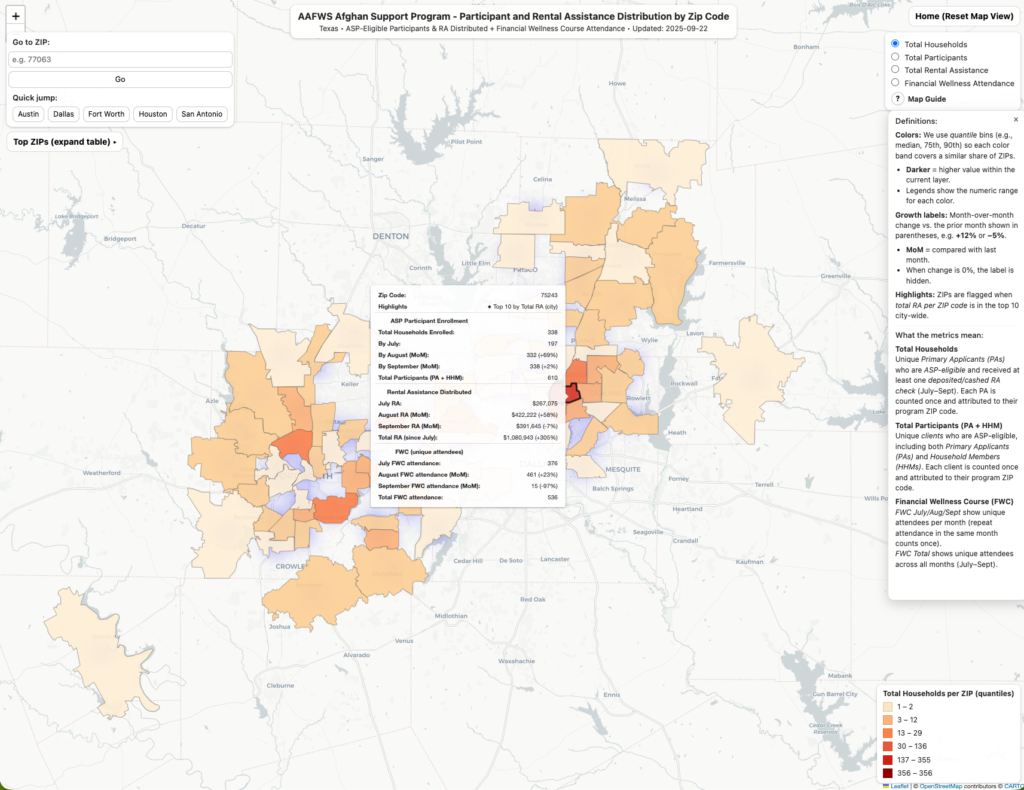
Interactive Geospatial Dashboard: Statewide Afghan Support Program & Rental Assistance Analytics
Organization: Cherokee Federal/ Texas Office for Refugees (TXOR)
Overview: Designed and built an interactive Python-driven geospatial mapping tool for the Texas Office for Refugees (TXOR) to visualize, track, and optimize state-level assistance distribution across major metropolitan hubs (Austin, Dallas, Fort Worth, Houston, San Antonio).
Key Technical & Operational Features:
- Geospatial & Quantile Mapping: Implemented choropleth heat map layers utilizing quantile binning to map participant density, total household distribution, and rental assistance allocations down to the ZIP code level.
- Dynamic Data Drill-Downs: Engineered dynamic tooltips and pop-up modal interfaces to display granular, month-over-month (MoM) performance metrics, unique participant counts, and total disbursements (e.g., tracking $1.07M+ in regional rental assistance).
- Interactive Navigation & UI: Integrated quick-jump city filters, ZIP-code search tools, dynamic legends, and customized layer controls (Total Households, Rental Assistance, Financial Wellness Course attendance) for executive and operational views.
- Operational Impact: Used tool findings to flag data reporting discrepancies, streamline case verification workflows, and accelerate assistance approval timelines for hundreds of eligible households.
Skills & Tools Used: Python • Geospatial Data Analysis • Choropleth & Heat Mapping • Data Visualization • Process Automation • Public Sector Analytics
Texas Refugee Medical Assistance (RMA) Interactive Spatial Analytics Map (FY19–FY24)
Organization: U.S. Committee for Refugees and Immigrants (USCRI)
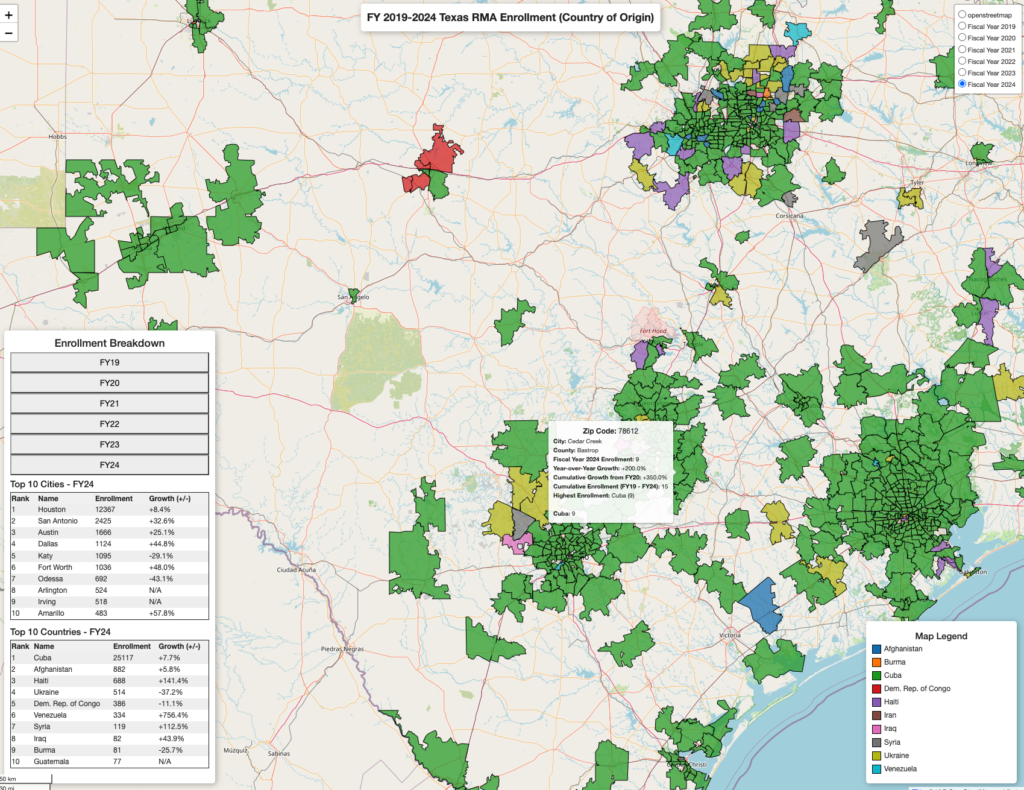
Overview: Developed an interactive spatial visualization tool designed to track, analyze, and present longitudinal trends in Refugee Medical Assistance (RMA) enrollment across Texas zip codes. Built using Python, Folium, and GeoJSON datasets, this tool transforms complex administrative healthcare data into accessible visual analytics to support public health policy, resource allocation, and program compliance evaluation.
Key Features & Technical Execution
- Longitudinal Temporal Analysis: Engineered individual, toggleable visual layers for Fiscal Years 2019 through 2024 to highlight demographic shifts and spatial migration trends across Texas metro areas.
- Interactive GeoJSON Mapping & Custom UI: Integrated dynamic tooltips providing localized insights (e.g., zip code-level enrollment volume, top countries of origin, and YoY percentage shifts) alongside an overlay dashboard featuring dynamic rankings and color-coded keys.
- Policy & Operations Impact: Uncovered key macro trends—such as Houston maintaining its role as the state’s leading resettlement hub and a ~40x surge in Cuban enrollments over five years—enabling agencies to proactively allocate healthcare funding and language-access resources.
- Technologies Used: Python, Folium, Pandas, GeoJSON, HTML/CSS, Data Visualization
Texas Statewide RMA Enrollment Analytics & Interactive Heat Mapping Framework
Organization: U.S. Committee for Refugees and Immigrants (USCRI)
Overview: Initiated and led a data analytics initiative to monitor statewide Refugee Medical Assistance (RMA) enrollment across Texas. After designing a foundational Power BI enrollment dashboard, expanded the effort into a quarterly reporting and geographic analytics framework to deliver actionable insights to leadership, resettlement agencies, and state partners.
Key Deliverables & Actions:
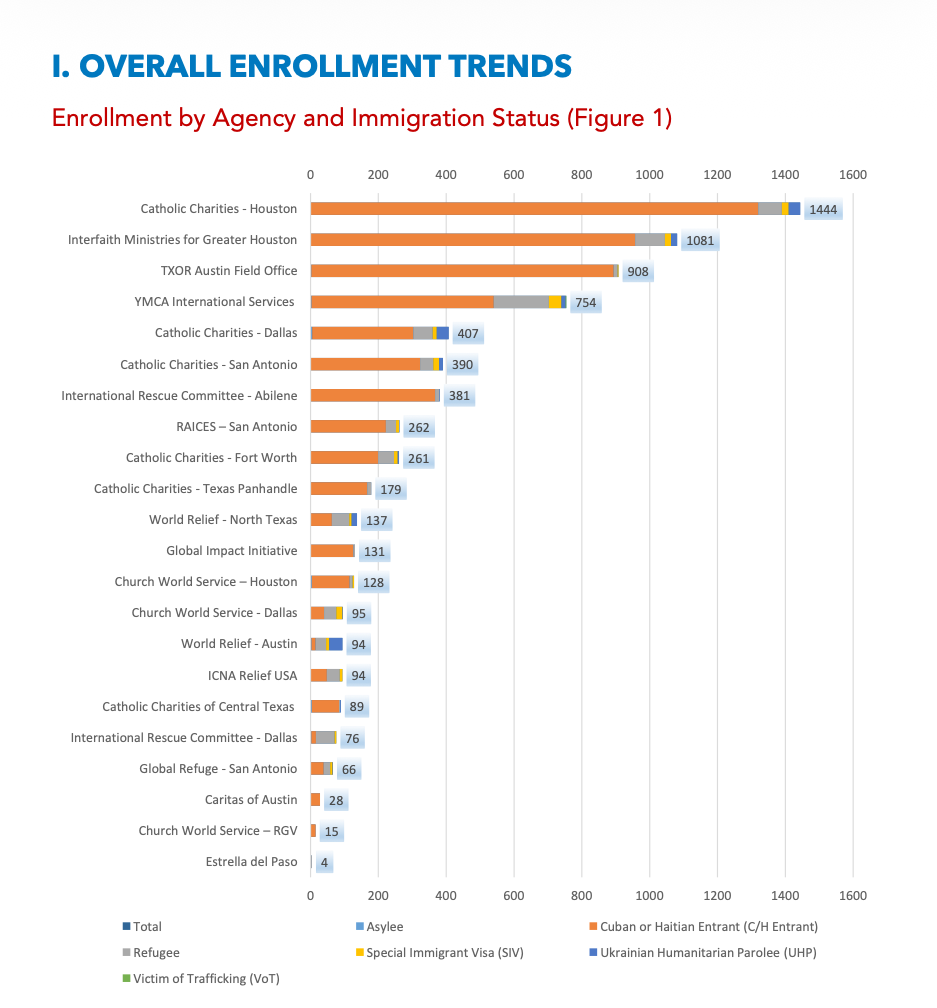
- Statewide Analytics & Reporting: Authored the FY25 Q1 Statewide RMA Enrollment Report, aggregating data across 20+ resettlement partner locations to evaluate 7,024 client enrollments.
- Interactive Heat Maps: Built dynamic, HTML/browser-accessible zip-code heat maps to visualize enrollment concentrations across major metropolitan areas (Houston, Dallas-Fort Worth, Austin, San Antonio) and regional hubs.
- Demographic & Policy Analysis: Analyzed key enrollment trends, tracking status distributions (e.g., Cuban/Haitian Entrants representing 83.4% of enrollments), language preferences, age/gender breakdowns, and conditional enrollment factors (e.g., 65+ age group).
- Stakeholder Alignment: Translated raw data into strategic visualizations, enabling executive leadership and partner agencies to optimize resource allocation, address compliance bottlenecks, and plan targeted outreach.
Impact: Transformed isolated case data into an interactive intelligence asset. Provided the organization with its first automated, multi-agency tracking framework to guide capacity planning and state-level policy discussions
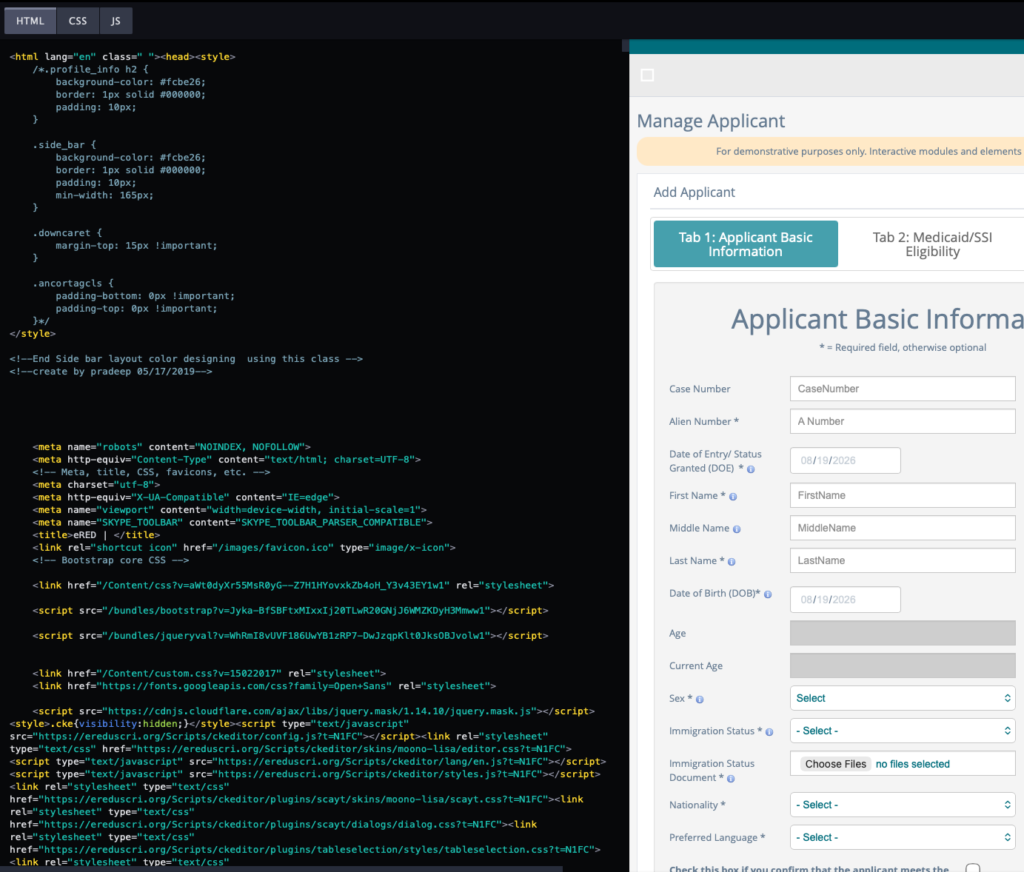
eRED RMA Application Portal Redesign & User Experience Modernization
Organization: U.S. Committee for Refugees and Immigrants (USCRI)
Overview: Refined and optimized the Electronic Refugee Initial Determination (eRED) web portal to streamline case processing for partner agency case managers. Focused on restructuring application elements to align with actual operational workflows and embedding policy guidance directly into the interface.
Key Deliverables & Actions:
- Intuitive Workflow Restructuring: Reordered application fields within the existing three-step structure to create a natural, efficient logical flow tailored to case managers’ daily entry habits.
- Interactive Policy Guidance: Integrated field-level tooltips throughout the form, providing instant, on-demand policy clarifications and guidance to reduce submission errors and minimize external policy lookups.
- Interactive Prototyping: Built a functional HTML/JS prototype incorporating the new field order and tooltip mechanics to demonstrate the user-centric workflow improvements to leadership.
Impact: Created a user-friendly, self-guiding application interface concept that reduced administrative confusion, improved compliance accuracy, and provided a blueprint for future portal iterations.
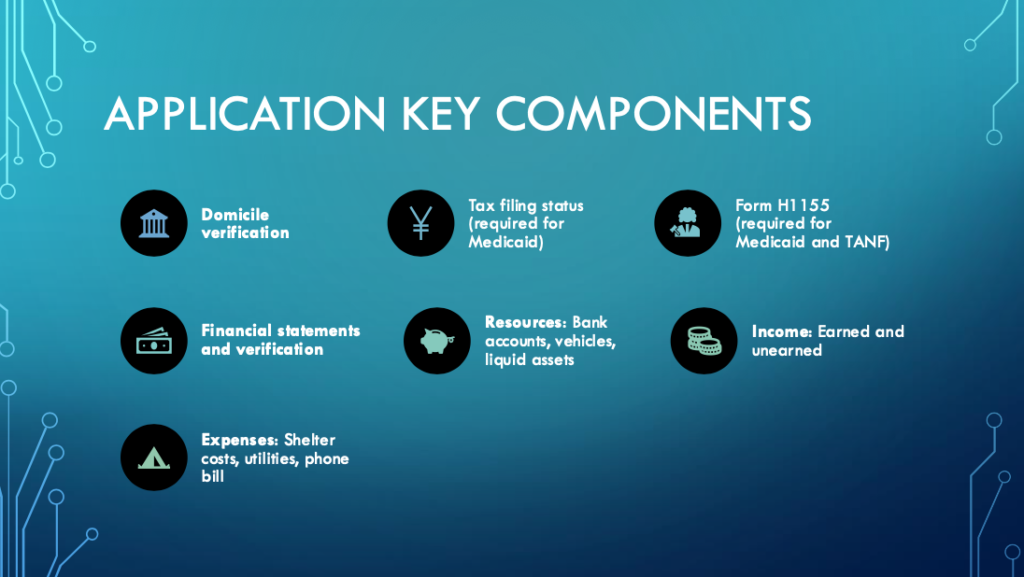
Statewide Public Assistance Training & Compliance Framework (SNAP/TANF/Medicaid)
Inter-Agency Instructional Deck & Regulatory Compliance Guide for Refugee Service Providers
Organization: Texas Office for Refugees (TXOR)
Overview: Developed and facilitated comprehensive training modules for partner agencies across Texas to standardize benefit application processing, reduce eligibility discrepancies, and navigate complex state regulatory guidelines (HHSC).
Key Portfolio Highlights:
- Complex Policy Translation: Visualized multi-program eligibility criteria, income threshold calculations, and immigration documentation verification workflows into accessible staff training modules.
- Operational Accuracy: Built technical guidance covering self-employment declarations (Form H1049), earned income projection formulas, and domicile verification standards.
- Appeals & Escalation Framework: Designed step-by-step checklists and template language for case managers to submit policy-backed benefit appeals under Texas Works Handbook guidelines.
Deliverables Included: Instructional Deck • Process Flowcharts • Verification Checklists • Sample Appeal Documentation
Skills & Tools: Policy Analysis • Instructional Design • Stakeholder Facilitation • Regulatory Compliance • SOP & Technical Writing